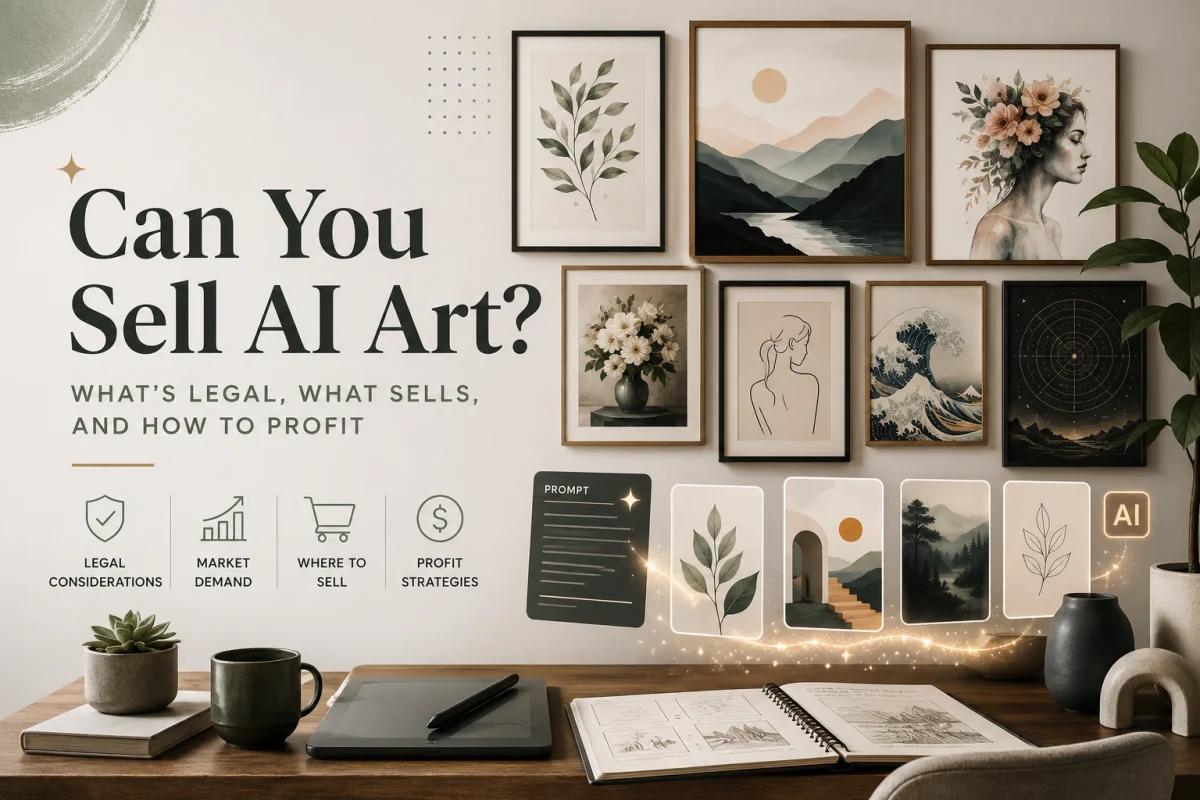
Can You Sell AI-Generated Art? The Commercial Use Guide for 2026
About the author

Louplr Team
Louplr Team shares practical guidance from building AI workflows for prompts, artwork, mockups, and listings used in real print-on-demand production.
This question comes up constantly, and the amount of misinformation out there is staggering. Some people claim all AI art is illegal to sell. Others think there are zero restrictions. The truth is somewhere in the middle, and it's actually pretty straightforward once you understand the basics.
The useful question is not only whether AI art is allowed. It is also what you can sell without building your shop on a shaky idea. So we will cover the rights side, the marketplace side, and the practical ways people turn AI images into Etsy products, print on demand listings, and digital downloads.
The Short Answer
Yes, you can sell AI-generated art commercially in most cases. The major AI image generation platforms (including OpenAI's DALL-E and GPT Image, Stability AI, Midjourney, and others) grant commercial usage rights to their users. If you generate an image using these tools and your account is in good standing, you're generally allowed to sell it.
But 'generally allowed' comes with important caveats. Let's go through them.
Where AI Art Actually Turns Into Revenue
The safer path is to use AI as a creative tool, then package the result as something buyers already understand. Most customers are not shopping for a raw image from a generator. They are shopping for a nursery print, a pet portrait, a birthday gift, a gallery wall set, or a poster that fits a room.
- Printable wall art: high-resolution files buyers can download and print themselves.
- Print on demand products: posters, canvas prints, apparel, mugs, tote bags, phone cases, and home decor without holding inventory.
- Digital bundles: coordinated sets, planner covers, patterns, clipart, coloring pages, or design assets.
- Custom products: personalized pet portraits, family name prints, nursery sets, or niche gift designs.
- Content-led shops: Pinterest, SEO, and seasonal planning that send steady traffic to a focused catalog.
Platform Terms of Service
Every AI image platform has its own terms. The good news is that most of them explicitly allow commercial use:
- OpenAI (DALL-E, GPT Image): Full commercial rights. You own the outputs you generate.
- Midjourney: Commercial rights included with paid plans. Free tier outputs cannot be used commercially.
- Stability AI: Open-weight models allow commercial use. Check specific model licenses.
- Most API-based models: Commercial use is typically allowed when accessed through paid API plans.
Always read the terms of service for whatever specific tool or model you're using. Terms can change, and newer models sometimes have different licensing.
Copyright Ownership of AI Art
This is where things get nuanced. In the United States, the Copyright Office has ruled that purely AI-generated images without meaningful human creative input cannot be copyrighted. This means you may not have exclusive copyright over a basic AI generation.
However, this doesn't mean you can't sell it. It means someone else could theoretically generate a similar image and also sell it. In practice, this rarely matters because the chances of someone generating an identical image from a different prompt are astronomically low.
If you significantly modify, curate, or arrange AI-generated images with your own creative decisions, the resulting work may qualify for copyright protection. The more human creative input, the stronger the case.
What You Should NOT Generate
The biggest legal risks with AI art come not from the 'AI' part but from what you ask the AI to create:
- Copyrighted characters: Don't generate Disney characters, Marvel heroes, or any recognizable IP. Even if the AI can do it, selling those images is trademark infringement.
- Specific artists' styles by name: Generating art 'in the style of [living artist]' raises ethical and potentially legal concerns. Use generic style descriptions instead.
- Real people's likenesses: Don't generate recognizable images of real people for commercial products without permission.
- Trademarked logos or brand elements: Even accidental inclusion of recognizable brand elements can create liability.
Best Practices for Commercial AI Art
- Use paid plans that explicitly grant commercial rights
- Generate original subjects and compositions: don't try to replicate existing copyrighted works
- Describe styles using technical art terms rather than specific artist names
- Keep records of your prompts and generation process
- Add your own creative decisions: style direction, color choices, composition edits, curation
- Review outputs for unintended copyrighted elements before listing
Commercial Checklist Before You List
Before publishing, slow down for a quick review. It is less exciting than generating more images, but it is the habit that keeps a shop cleaner, safer, and easier for buyers to trust.
- Confirm the image model or platform allows commercial use for your account type.
- Save the prompt, generation date, tool name, and any meaningful edits in your product notes.
- Check the output for accidental logos, signatures, brand names, celebrity likenesses, or recognizable characters.
- Upscale the artwork to the size you plan to sell, then inspect it at 100 percent zoom.
- Use realistic mockups so buyers understand scale, texture, and where the product belongs.
- Write clear listing copy and follow the disclosure rules of the marketplace you are using.
What About Etsy and Other Marketplaces?
Etsy allows AI-generated art to be sold. Their policy requires sellers to disclose if a product was created with AI assistance, which is a reasonable transparency measure. Most other marketplaces have similar policies, they allow AI art but expect disclosure.
The marketplace risk isn't legal, it's perception. Some buyers specifically avoid AI art, while others don't care as long as the product looks good. Focus on quality and let your work speak for itself.
A Simple Way to Build Around AI Art
If you want AI art to become a real side income, avoid making random one-off images forever. Start with a niche, make a small collection, and move each piece through the same basic path: Prompt Generator for a clearer brief, Artwork Generator for the image, Artwork Upscaler for print quality, Mockup Generator for listing visuals, and Content Generator for titles and descriptions you can refine before publishing.
- Pick a niche with visible demand, such as nursery wall art, pet gifts, botanical printable sets, teacher gifts, or seasonal decor.
- Create a small collection so the shop feels intentional and buyers can buy more than one piece.
- Prepare print-ready files and mockups before writing the listing; presentation affects trust as much as the art itself.
- Use Etsy SEO or marketplace SEO in plain language: subject, style, room, occasion, product type, and delivery format.
- Watch which products get views, favorites, and sales, then make more work around those signals.
The Practical Reality
Thousands of sellers are building legitimate businesses selling AI-generated art right now. The legal landscape is evolving, but the direction is clear: AI is a tool, and using it to create products is treated similarly to using Photoshop or any other design software.
Focus on creating genuinely useful, beautiful products that buyers want to put in their homes. That's what actually matters for building a sustainable business.
Frequently Asked Questions
- Can I legally sell AI-generated art?
- In most cases, yes, as long as the AI platform's terms allow commercial use and the image does not rely on copyrighted characters, trademarks, real people's likenesses, or another artist's protected work. Check the terms for the exact model and account type you use.
- Can I make money with AI art on Etsy?
- Yes, but the product still has to be something buyers want. Printable wall art, POD posters, nursery sets, pet gifts, and seasonal decor can all work when the art is polished, the mockups are strong, and the listing matches real search behavior.
- Do I need to disclose that artwork was made with AI?
- Marketplace policies vary, but transparency is usually the safest choice. Be especially careful with handmade, custom, and original claims. Buyers should understand what they are purchasing and how it was made when that detail matters.
- Can AI-generated art be copyrighted?
- Pure AI output may not qualify for copyright protection in some places, including the United States, without meaningful human creative input. You can still sell the product, but your stronger protection usually comes from your editing, curation, arrangement, branding, and product presentation.