AI-Powered Print on Demand: A Practical 2026 Workflow From Idea to Listing
About the author

Louplr Team
Louplr Team shares practical guidance from building AI workflows for prompts, artwork, mockups, and listings used in real print-on-demand production.
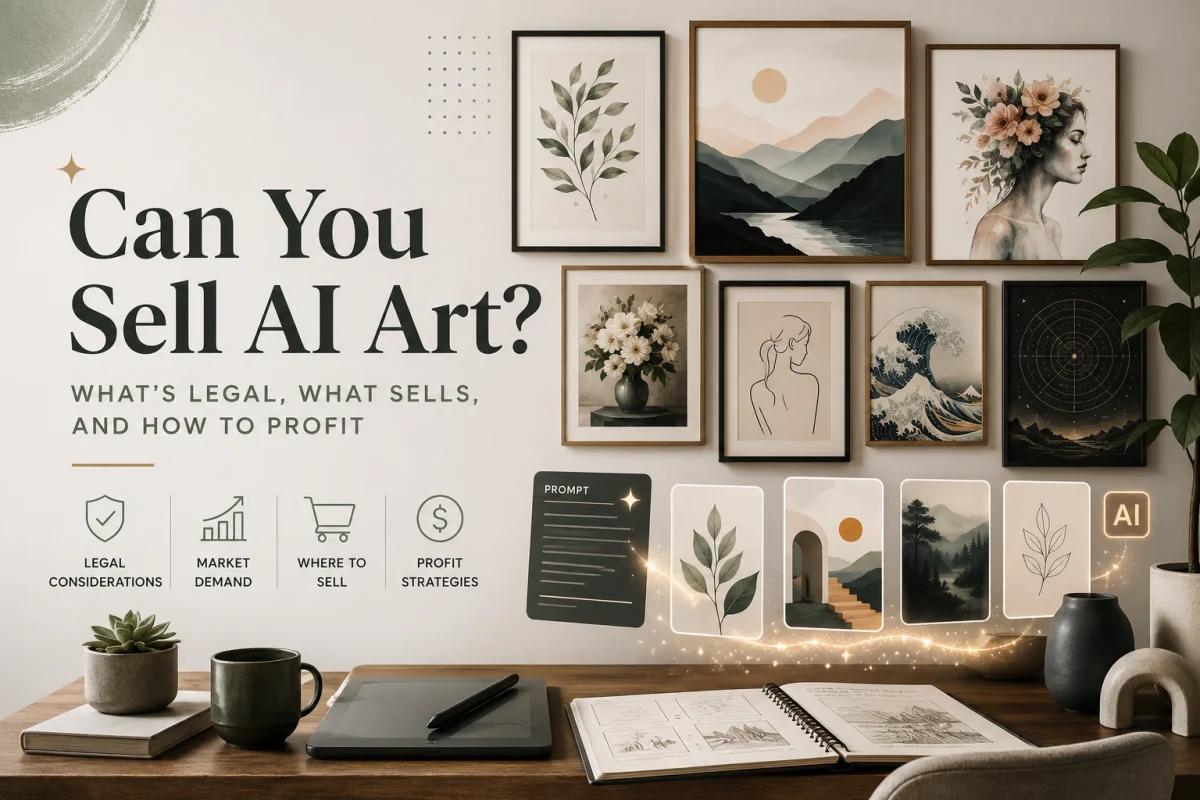
AI has changed print on demand, but not in the lazy-button way people imagine. It does not guarantee good products. What it does well is remove repetitive production steps so you can spend more time on selection, positioning, and testing.
If you want to use AI for POD in 2026, the goal is not to generate more images than everyone else. The goal is to build a workflow that gets you from niche idea to finished listing faster without lowering quality.
Why AI Changed the POD Game Completely
Print on demand has always rewarded volume, but the real bottleneck was production time. Coming up with artwork, preparing print-ready files, building mockups, and writing listings could easily consume hours per product.
AI can shorten ideation, image generation, upscaling, mockups, and copywriting, but only if you use it selectively. Fast output is useless if the art is generic, the resolution is weak, or the final listing does not fit buyer intent.
The right way to think about AI is as a multiplier, not a substitute for judgment. It helps you move faster once you know what good looks like.
The AI-Powered POD Workflow: Step by Step
A useful AI-powered POD workflow starts before the image generation step. It begins with niche clarity, then uses AI to speed up production without removing human review.
Step 1: AI Prompt Generation
It starts with a niche and a product angle, not just a random prompt. Good prompt generation turns a loose idea into a usable brief: subject, style, palette, composition, mood, and exclusions.
For example, 'Japanese cherry blossom wall art' becomes much more useful when the prompt specifies medium, palette, composition, and mood. That level of direction usually produces more commercially usable results than a vague prompt like 'cherry blossom poster.'
Step 2: AI Artwork Generation
With the brief in place, you can generate artwork. Modern image models are good enough for many commercial use cases, but model choice still matters. Some tools are better at photorealism, some at painterly styles, and some at graphic or minimalist compositions.
Generate variations, then cull aggressively. The point is not to save every result. It is to keep only the outputs that hold up at thumbnail size, look believable in a product context, and do not contain obvious artifacts or accidental text.
Step 3: AI Upscaling
This step is non-negotiable for print products. Raw AI outputs are typically 1024x1024 pixels. Print products need 3000-6000 pixels depending on the size. AI upscalers don't just stretch the image; they intelligently add detail and sharpness.
A common mistake is skipping upscaling to save time. Don't. The quality difference between a 1024px image stretched to poster size and a properly upscaled 4096px image is immediately visible to buyers. It's the difference between a product that looks premium and one that looks amateur. Our upscaler tutorial explains resolution requirements for different print sizes.
Step 4: AI Mockup Generation
Once the artwork is print-ready, you need mockups that bridge the gap between art file and product offer. That can mean posters in realistic interiors, apparel on believable models, or mugs in giftable scenes.
Strong mockups reduce uncertainty. They help buyers understand scale, room fit, and overall feel, which can improve click-through and conversion. AI mockups are useful because they make it easier to create multiple scenes without a large asset library.
Step 5: AI Content Generation
The final piece is listing content: titles, descriptions, and tags that reflect how buyers actually search. AI is useful here because it can generate first drafts quickly and suggest more keyword coverage than many sellers think of manually.
The important part is review. AI can save time, but it should not publish blindly. The strongest listings still come from editing the draft against real buyer language, competitive search results, and the actual product angle.
AI Art Styles That Sell Best
Not every AI-generated style translates equally well to print on demand. The styles below tend to work because they are visually clear, easy to merchandise, and broad enough to create collections around.
- Watercolor botanicals and florals: easy to style in home decor listings and flexible enough for series or sets.
- Minimalist line art: clean, modern, and usually easy to generate without visual clutter.
- Vintage travel posters: high perceived value and strong niche appeal when the composition feels intentional.
- Abstract geometric art: useful for modern interiors and gallery wall bundles.
- Digital collage and mixed media: distinctive enough to stand out when the color palette stays controlled.
- Dark moody aesthetics: strong fit for specific rooms and audiences when the imagery stays printable and clear.
Our deep dive into AI art styles that sell has detailed analysis on each style with marketplace data.
The Commercial Rights Question: Can You Sell AI Art?
Usually yes, but do not treat commercial rights as one blanket rule. Rights depend on the tool, the subscription tier, the provider terms, and sometimes the marketplace where you plan to sell.
The safest approach is to create original subject matter in broad styles without referencing copyrighted characters, brand assets, or specific living artists. Clean prompts, original compositions, and regular checks of provider terms reduce risk.
Prompt Engineering for Product Design
The quality of your AI output is directly proportional to the quality of your input. A prompt like 'cat art' produces generic results. A prompt like 'elegant Siamese cat portrait in Japanese sumi-e ink style, minimalist composition on off-white background, subtle cherry blossom branch in corner, refined brushstrokes with varying ink density' produces something you'd frame.
Good prompts for POD include: the subject, the art style, the color palette, the composition, the mood, and importantly, what NOT to include (no text, no borders, no watermarks). Our comprehensive guide to AI prompt engineering for product design has prompt templates for every major style.
Building a Consistent Brand with AI
Random one-off designs can sell, but collections are usually easier to scale. When a buyer likes one piece, they often want a matching second or third item, especially in wall art.
AI makes consistency easier when you save prompt structures, style language, and palette rules. A collection works best when buyers can tell the pieces belong together without the shop feeling repetitive.
The Full Automation Pipeline: How Louplr Works
Louplr was built specifically for the AI-powered POD workflow. Instead of using 5 different tools (a prompt generator, an AI art model, an upscaler, a mockup tool, and a content writer), everything runs in a single pipeline.
- Enter a keyword or niche ('Japanese cherry blossom wall art')
- AI generates detailed prompts tailored for sellable product artwork
- Select your favorites and generate artwork variations
- One-click upscale to print resolution (up to 4096px and beyond)
- Place artwork on product mockups (posters, t-shirts, mugs) with lifestyle scenes
- Generate SEO-optimized titles, descriptions, and tags
- Export everything ready to upload to Etsy, Shopify, or any marketplace
Once the workflow is dialed in, the process becomes much faster than a manual pipeline. The biggest gains come from standardizing the steps, not from removing human review.
Common Mistakes in AI-Powered POD
- Using raw AI outputs without upscaling. Print quality suffers and you get bad reviews.
- Not curating results. AI generates duds too. Be ruthless about quality selection.
- Over-relying on a single prompt style. Buyers scroll past products that look the same. Vary your approach.
- Ignoring the listing optimization side. A great design with terrible SEO is invisible.
- Skipping mockups to save time. This is the one shortcut that directly kills conversion rates.
- Generating art with unintentional text, logos, or symbols. Always check before listing.
AI Tools Compared for POD Sellers
The AI tool landscape is crowded. For POD sellers specifically, you need tools that understand print requirements (resolution, aspect ratio, safe areas) and marketplace requirements (SEO, listing structure).
Generic AI art generators (Midjourney, DALL-E, Stable Diffusion) produce great imagery but require manual work for everything after generation. POD-specific tools like Louplr automate the full workflow. Our comparison of the best AI art generators for 2026 evaluates each option from a POD seller's perspective.
Getting Started: Your First AI-Powered Product
- Sign up for Louplr (1,000 free tokens included)
- Enter a keyword for your niche (e.g., 'minimalist mountain landscape')
- Generate prompts and pick your favorites
- Generate artwork variations and select the best result
- Upscale to print resolution
- Create mockups with the built-in placement tool
- Generate product titles, descriptions, and tags
- Upload to your Etsy or Shopify store
Your first few products will take longer because you are building the system as you go. Speed comes after you define what counts as a strong prompt, a usable image, a print-ready file, and a mockup worth publishing.
AI for Print on Demand FAQ
- Is AI-generated art good enough to sell as print on demand products?
- Yes, in many niches the quality is high enough to sell, provided the artwork is well selected, properly upscaled, and free from obvious artifacts. The tool alone is not enough. Quality control matters.
- Do I need art skills to use AI for print on demand?
- You do not need traditional art skills, but you do need curation skills. The more clearly you can describe style, composition, and exclusions, the better your outputs usually become.
- Can buyers tell if a product was made with AI?
- Sometimes yes, especially when the image has visible artifacts, weak anatomy, accidental text, or generic composition. What buyers notice first is quality, not the tool name behind the image.
- How many products can I create per day with AI tools?
- That depends on product complexity, how much editing you do, and whether you are building a collection or a one-off listing. AI usually increases throughput, but quality review still sets the real limit.
- What happens if AI-generated art becomes oversaturated on marketplaces?
- Generic styles and broad niches get crowded fastest. The way around that is better positioning, stronger collections, clearer product-market fit, and better presentation, not just more image generation.
- Should I tell buyers my art was made with AI?
- That depends on the marketplace rules you sell under and the brand relationship you want with buyers. Some sellers disclose it directly, others describe the work more generally as digital artwork. Check platform policies and stay consistent with your brand approach.